
PSD – RCMP SERVICE DOG – Dirk
The Gallery
The Nameplates
Pillar Location: RCMP SERVICE DOGS / GRC CHIENS DE SERVICE
The Stories
The relationship between a police service dog and its master is complex and deeply bound. There needs to be trust, communication, non-verbal signals, endurance, strength, and an emotional bond between them. When you combine the dangers of the job with their relationship it takes on a bond and loyalty that goes beyond words. It is not just a job. They work, play, and live together 24/7. They take down suspected criminals, find drugs and explosives, and perform search and rescue for those lost in harsh environments. Then they come home together for rest and recuperation. With a solid partnership and deep connection, they then perform heroic jobs that neither could do alone.
Dirk was among the first dogs to provide policing services in Canada. In today’s world, they are the norm and have expanded into so many further uses as a result. However, in the 1960s, police dog masters had an uphill task in selling the use of their dogs to detachments and their members. They had to show what they were capable of and act somewhat like a salesman and sell their services. They had to pursue files and promote their successes to higher senior management. This took years and many sleepless nights, running out at all hours, no schedule, and 24/7 work. There weren’t many dog masters per province and in B.C. they started with 2 and progressed to 5 by the 1970s. Toda,y there are 65 teams of Police Service Dogs with the RCMP in B.C. alone. They broke through barriers and the results spoke for themselves. They had to cover an enormous amount of geography. Some of the following are examples of those breakthroughs in the 1960s.
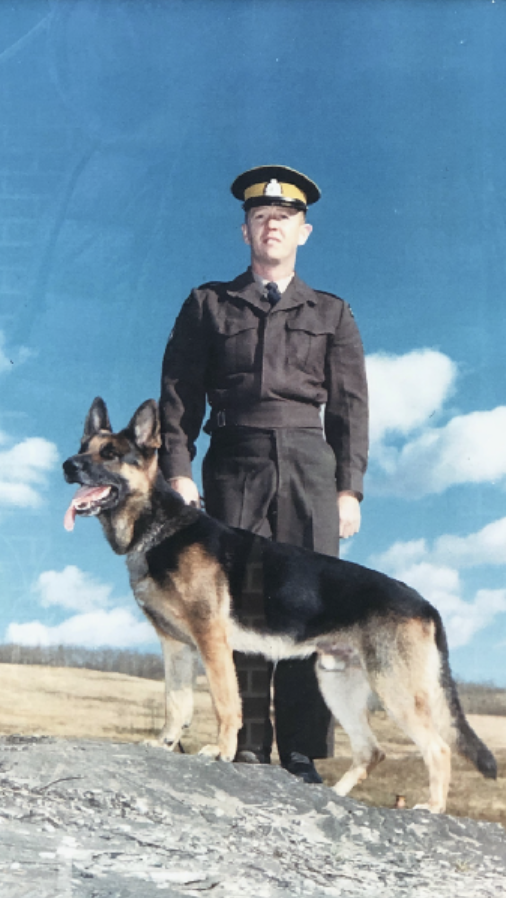
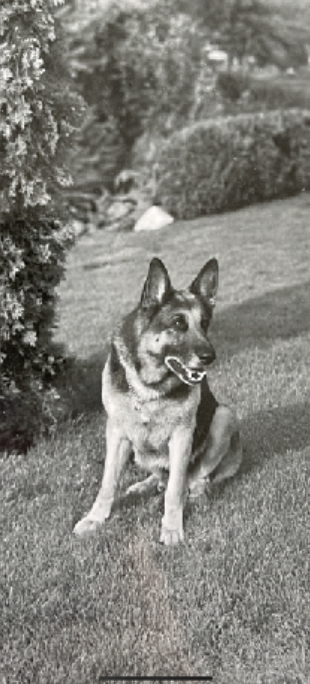
Dirk, Regimental #10, bred by RCMP ex-trainer Gord Teeft and trained by Les Knoll. He was raised in a family environment. Sired 2 other Police Dogs, Brandy and Billy. He was mostly black with orange and tan markings, weighing 110 lbs. Constable R.L. Marshall commenced working with Dirk in 1966. Dirk was 1 of 5 police service dogs on duty in British Columbia at the time.
Most notably, Dirk was among the first Police Service Dogs trained in searching for marijuana. On September 19, 1968, Dirk was assigned to be used in a variety of actual situations to initiate his training in searching for marijuana. On Sept. 20, 1968, Dirk and Cst. Marshall accompanied members of the Drug section at the border crossing at Douglas, B.C. for "the purpose of searching suspected automobiles which might contain marijuana”. Several vehicles were searched by Dirk resulting in two seizures. Dirk clawed vigorously at the rubber floor matting which was rolled back to expose a piece of metal which Cst. Marshall removed and found a plastic bag containing 22 tablets of black LSD. Dirk further indicated there was something more hidden under the panelling of the dashboard. At this time the suspect stated, "it’s under the ashtray”. They recovered a pipe bowl and some burnt plant material which was analyzed to be marijuana.
Due to this new search and seizure utilizing Dirk, the news media, public, and authorities were favourable to launching this form of search by the drug section.
On September 26, 1968, Dirk accompanied drug investigators on searches of three residences. “The handling and conduct of Dirk was commendable. Dirk located a cash of 15 grams of hashish in a garage, which in all likelihood would not have otherwise been discovered”.
From that point on Cst. Marshall was to continue utilizing Dirk in this capacity and reporting back to the RCMP training kennels in Innisfail, Alberta so that the NCO of the kennels might be familiar with the success and difficulties encountered. Thus, the beginning of drug search and seizures utilizing police service dogs.
There were many criminal apprehensions for Dirk. One of note received a commendation for their work apprehending an armed criminal near Agassiz, B.C.. Cst. Marshall and Dirk were commended for their “courageous conduct that resulted in the criminal being apprehended immediately which no doubt prevented a more serious situation from developing due to the assistance of Dirk. Neither dog nor officer was harmed."
The following call demonstrates the amazing abilities of Police Service Dogs to retrieve all kinds of evidence and what kind of partner they truly are. On July 20, 1967, Dirk was utilized on a call for Possession of a Weapon in Burnaby, B.C.. When Cst. Marshall and Dirk attended the scene, RCMP members had 3 suspects apprehended. Upon arrival, they had one .22 calibre rifle obtained. Shortly after arrival, a 4th suspect appeared from the bush. Cst. Marshall recommended they be taken to the detachment to be further interviewed and he would conduct his search with the dog. Upon moving the suspects to the vehicle, one suspect made a motion to turn on Cst. Marshall. Dirk immediately had him by the arm, protecting his partner. Once the suspects had been removed, Dirk was utilized to search the area where the alleged offence occurred. While searching the area, Dirk commenced digging until he retrieved a loaded revolver which was buried 10 inches below the surface. Continuing the search, Dirk located a second revolver that had been thrown into the bush. Again, Dirk had shown his ability to retrieve needed and hidden evidence.
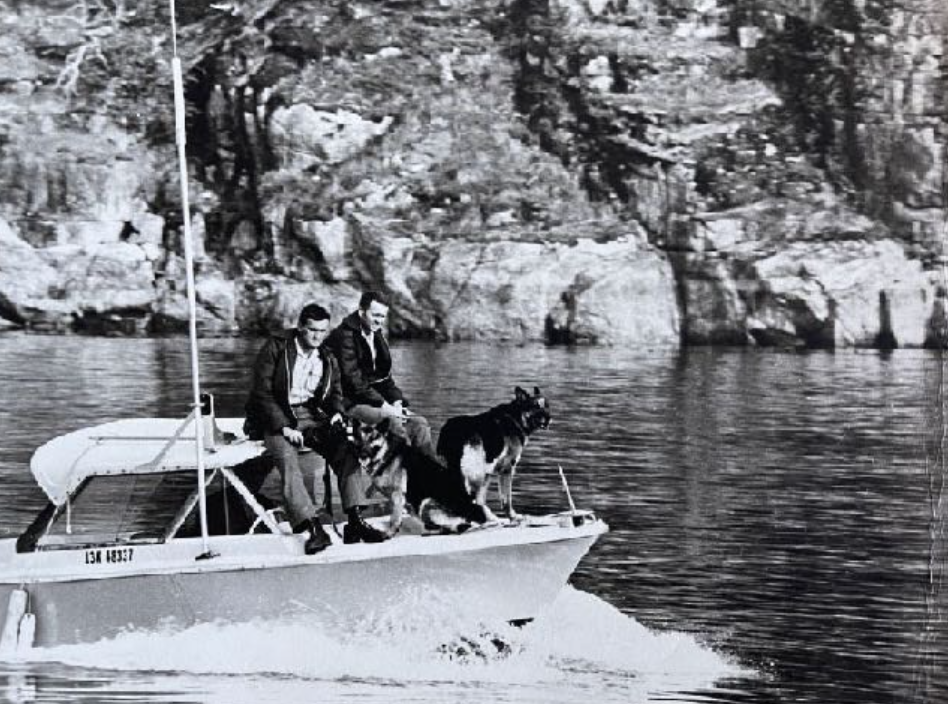
After commendable service with Dirk, Robert Marshall received a promotion to Corporal. One of the first cases in this new title highlights the challenges Police Service Dogs face in the weather and terrain of British Columbia. It was November 1969, off the west coast of Central BC. Ed Hadgkiss and Kathy Rheum had been flying in the fall/winter and the weather was rapidly changing and became treacherous. Hadgkiss had to adjust his flight plans several times en route due to weather. As a result, he ran out of fuel and was forced to land. Ed took the plane down atop a ridge line on Roderick Island. The terrain was rocky, full of crevices and trees. The plane scraped along the rough icy terrain, flipping it over and leaving it upside down next to a cliff edge.
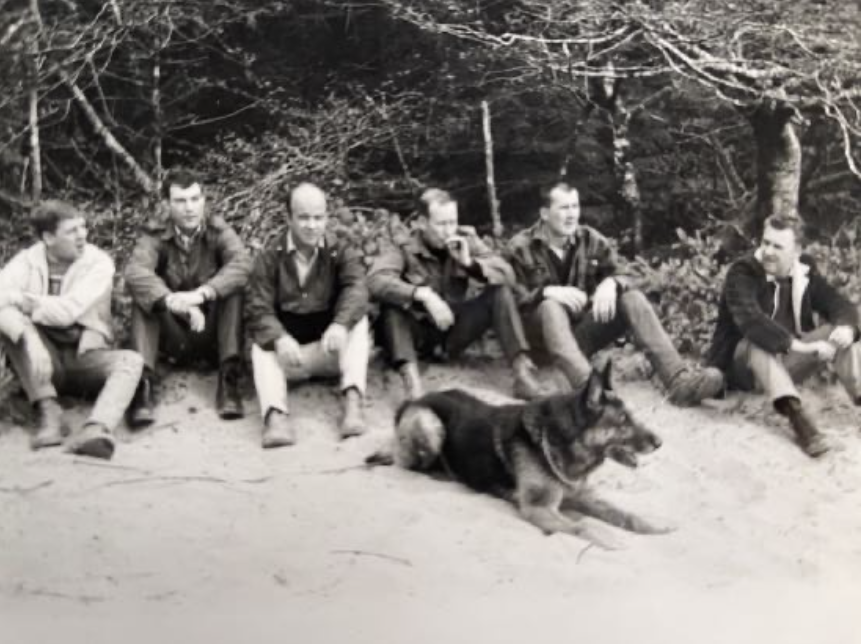
Cpl. Marshall and Dirk, along with two other dog masters and five Air Sea Rescue persons, were brought into an abandoned fishing cannery. They used the building as a base camp where they slept on the wooden floors and had supplies brought in. Each morning the Police Service Dogs and dog masters were helicoptered to the island at the top, where they would spend an entire arduous day in treacherous terrain performing their search in winter conditions. There was upwards of 20 feet of snow in some areas, temperatures reaching -20ºC with
the wind, and dense brush and trees lined the entire island right to the water's edge. There were no beaches; just rock, ice, snow, dense brush, and trees. It would take upwards of 7 hours to hike one mile.
On the first day of their search, as they approached the island, they saw a pack of wolves scrambling their way up to the plane. The plane lay amongst some trees upsidedown surrounded by cliffs dropping 200 feet. Upon searching the plane they found a note from the couple, stating they had set up camp but left to head
down to the water's edge to build a fire near a shipping lane in the hopes a boat would rescue them. The team maintained their search every day going to the island in this tough, unforgiving environment for a week. Arriving at dawn and leaving at dusk. Unfortunately, the couple was never found. Dirk and Cpl. Marshall returned the next spring attempting another search, again to find no sign of the couple.
In addition to his police service duties, Dirk and Cpl. Marshall were trained in Parks Canada Mountain Rescue (search and rescue). In February of 1972, the Coquitlam chapter of Search and Rescue began and Dirk was part of the first case to search and locate 2 teenage boys that had climbed Burke Mountain into Munro Lake. The hike into Munro Lake is treacherous, with many cliffs and geographical challenges. Tragically, they were located with one of the teens not having survived. Dirk continued on to complete many rescues including avalanche searches until he retired.
Dirk was bred, raised, and trained as a police dog first and foremost but he was also a family dog. Out of the three Police Service Dogs my father had, Dirk was the one that fit seamlessly into our family like a sibling. He loved hanging out with us and enjoyed a good ice cream cone. He was a gentle giant at home, however, he knew his job and he did it exceedingly well. He had an ability to pivot between work and home life. For example, when my brother was 2 years old, he decided to go after Dirk with a broom. Under work circumstances, that would have prompted Dirk into action to defend and take down a person, however, under family conditions, Dirk gently grabbed my brother by the arm and pulled him from the broom. Not a mark on him.
Dirk rose up to all that was asked of him. He was exceptional in all he did; Search and Rescue, Drug Search and Seizure, evidence retrieval, and criminal takedowns.
A heroic, loyal, gentle giant and friend.
Dirk Regimental #10 was decommissioned in 1971.
Pillar Location: RCMP SERVICE DOGS / GRC CHIENS DE SERVICE
Regimental Number: 10