Policing Prince Rupert, B.C. – 1958
Author: Robert (Bob) Head, A/Commissioner (rtd)
Regimental Number 18465 – 0.806
For this review, although The Indian Act was in place in 1958 (after several iterations since its 1867 inception), the term Indigenous will be used as reference to the collective of First Nations, Inuit, Metis, and Aboriginal populations.
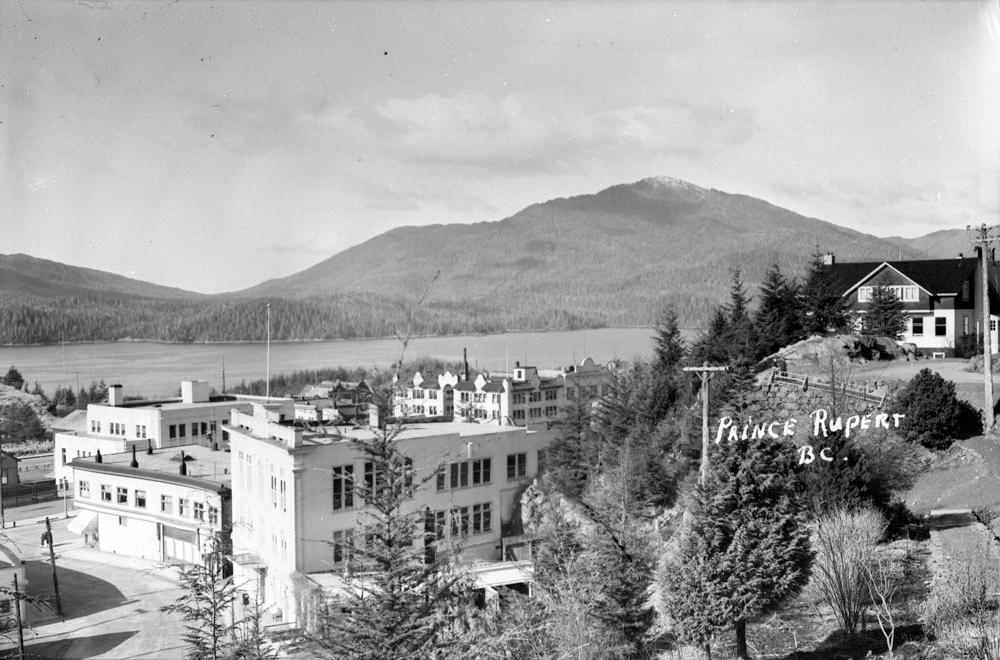
In 1958, Prince Rupert B.C was a bustling city of approximately 11,000 residents (estimated from Statistics Canada census figures from 1956 to 61), plus a wide and diverse variety of itinerant weekend fishermen, nearby Port Edward cannery workers, loggers and a few criminals seeking to take advantage of the ample pay cheques that were in the pockets of workers. Salaries were generous and cash was the feedstock from those earning it legally from the ocean, the forests and the local pulp mill. A significant portion of the population was at that time Indigenous. The Vancouver Sun, quoting Harold Sinclair, a cannery worker and Aboriginal spokesman saying it was the “largest [Indigenous] population of any city in B.C”.
The RCMP was (and still is) the police agency under Municipal contract with the City of Prince Rupert. At that time, Prince Rupert was designated as a SubDivision of “E” Division British Columbia. Inspector Bert Bloxham commanded this Sub-Division, covering the north coastal area of the province and easterly along Highway #16 to Smithers and Burns Lake.
The Municipal Detachment consisted of approximately 20 members assigned exclusively to policing Prince Rupert. This cadre of members (all male in that era) comprised a Staff Sergeant-in-Charge, a Sergeant as second in command and three Corporals as shift supervisors, plus fifteen Constables distributed over the three shifts. Although some of the constables were unmarried, the majority were ‘newly married’ under what was then called ‘the three-year plan’. It was simply that the Force would permit marriage after three years’ service, contingent on serving applicants being agreeable to assume municipal policing duties. Detachments adhering to “the three-year plan” included Prince Rupert, Prince George, Burnaby, Nanaimo, Red Deer AB., North Battleford, Yorkton, Sask., and others.
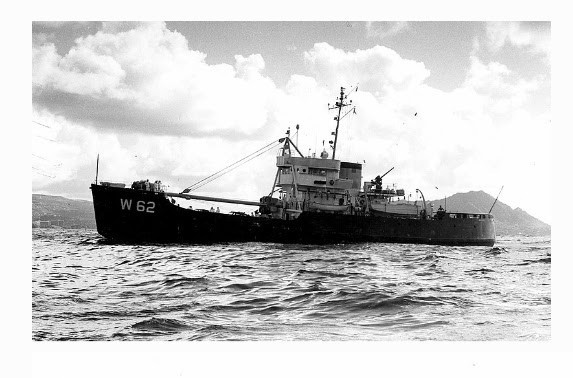
I recall the seemingly doubling of Prince Rupert’s population during the 1958 Prince 1 Rupert “Port Days” which comprised of August weekend events like log climbing/rolling, baseball/softball and basketball. The berthing of the “Balsam”, a U.S. Coast Guard ship, and its shore bound crew simply added to the city’s excitement. All day-assigned policing staff (including myself) were ordered to continue on duty for the 4 pm-12 midnight shift. By 5 pm, our cells already housed at least 26 prisoners, mostly from those intoxicated and arrested on the streets.
Our detachment vehicles were Dodge sedans and vans for overseeing patrolling NCO’s and partnered patrolling constables, respectively. The remainder of policing was conducted by foot patrol.
The Unlawful Assembly
As the 1958 Port Days’ sporting competitions were winding down, the multiple drinking establishments were winding up! Liquor was flowing in good quantity throughout the afternoon and into the evening. My partner, Cst. W.M. (Bill) Saunders and I were on foot patrol in the run-down urban area of the city where the bars were located.
At about 10:45 pm, we noticed a small group of persons engaged in an alcohol fueled disturbance on a street crowded with vehicles and pedestrians. We quickly entered the fray in an attempt to break up this inebriated clash between family members from another coastal Indigenous community. Our only patrol van arrived to assist with loading the two antagonists. In the interim, a larger crowd had gathered and the police were the targets.
With our backs to the van, Bill and I faced the crowd and swung our batons back and forth as the van moved slowly over the two blocks to reach the office. The van driver appealed for backup to hold the increasing crowd at the intersection about 30 yards from the detachment. The van continued to the detachment back door to unload the prisoners. Member reinforcements braved the mob, that had increased to about 1,200 persons, whose intent was to overtake the detachment and release the prisoners. Despite continuing to hold off the chaotic skirmish, some members were injured from rocks and bottles used as weapons and hand to hand scuffles. To assist, the city’s newly acquired LaFrance firetruck deployed its high-pressure water jet to hold back the crowd. Peter Lester, the then presiding Mayor, mounted the firetruck to recite “the Riot Act”. This was a warning to the crowd that police had the authority to levy punishment if the insurgents did not disperse. The firetruck sustained considerable damage from the thrown projectiles but fortunately, the Mayor was unharmed.
At that time, there was a supply of tear gas maintained at the Sub-Division office several blocks away, but only one of the enforcement members had ever had gas training. So, at the height of the fray, Cpl. Jim Riddell, the only member with gas training, brought the gas cache through the back door of the office and provided very cursory instruction on how to use the small hand-held firing devices. Eventually the incident’s Officer Commanding arrived at the detachment but was reluctant to authorize tear gas usage until a female rebel absconded with his Christmas-given wrist watch. Even though the tear gas was effective in controlling the crowd, there was some collateral damage amongst the members. An example was the premarture detonation of the gas device that knocked S/Sgt. Wally Todd partially unconscious. Transport of S/Sgt. Todd to the hospital for treatment was deployed through the back streets.
With no RCMP issue riot gear or helmets, we luckily did not sustain too many injuries and some incidents were humerous in retrospect. For example, a WW2 helmet somehow surfaced at the scene and it saved a rock to the head of the Constable that donned it even though the rock tipped the helmet over his eyes. In another instance, while chasing a rock wielding young lad, the high-pressure firehose jet hit us both in the back. We torpedoed the corner drugstore display window with me landing on top of the 20 year old. I managed to avoid lifethreatening injury from the jagged broken glass above my neck and sustained only a small cut to my hand through my leather glove. The young fellow did not fare as well and was dragged behind the line to be taken to the hospital for repair.
The unlawful disturbance lasted until about 1:30 am with about 86 prisoners in our crowded cells. The US Coast Guard Shore Patrol had lent assistance to us through the disturbance and were a significant help. The crowd had dispersed except for a few stragglers and they were more or less sobered up and their confrontational mood had subsided. Most of the members were a bit tattered and torn. In my own case, I went home to replace my uniform as all that remained of my shirt was the detachable collar.
The Aftermath
Insofar as alcohol consumption was concerned, the Indigenous citizen of the day was only permitted consumption in a legal drinking establishment, i.e. a hotel bar. They were prohibited from purchasing alcohol beverages off premises at a bar or liquor store unless they were identified as “Enfranchised”. Discrimination was clearly evident. Enfranchisement was a legal process for terminating a person’s Indigenous status and conferring full Canadian citizenship to the individual. Records indicate that fewer than 500 volunteered to become enfranchised. Many were reluctant to renounce their Indigenous status as it would legally affect their homeland status. Mayor Lester in a Vancouver Sun quote, summed up the 1958 August Port Days aftermath on behalf of a segment of those arrested. “[Indigenous] can only drink in beer parlors and not in their homes. They don’t like it”.
The media follow-up brought forth a wide variety of opinions, but one common theme was that the RCMP were at fault with their prevalent discrimination. In fact, there was discrimination, not by the police versus the Indigenous population, but by Canada, over the previous century leading up to the event.
We ought to bear in mind that a sizeable portion participating in the rioting crowd was of European descent. As pointed out by The Prince Rupert Daily News “the racial crowd makes no difference…those getting the most kick out of things on Saturday night were predominately white”.
Court cases dragged on for some time, but as I recall, the most severe sentence was six months, given to a young white man, the one who smashed a beer bottle over the nose of Cst. R.B.T. Sherwood.
All in all, this was a weekend to remember!
Robert (Bob) Head, A/Commissioner (rtd) #18465 – 0.806
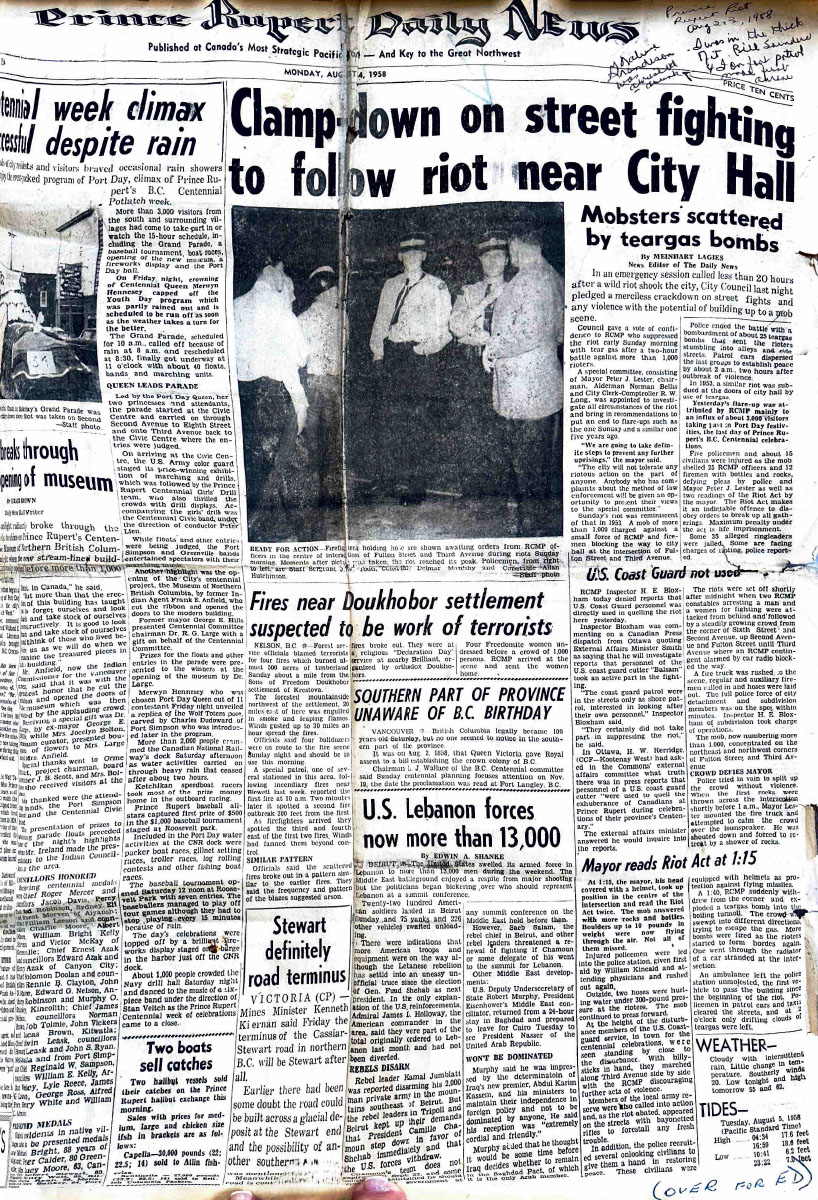
Reported in the Prince Rupert Daily News on August 04, 1958
Prince_Rupert_Riot1958_Article
princerupert-58